
Tunnel Effect #
This effect serves as proof of the wave nature of electrons.
Assume the height of the energy barrier $V_1$ is sufficiently high and greater than the energy of the electron. If the electron is considered a particle, it cannot overcome this barrier and is entirely reflected at the boundary. However, if the electron is considered a wave, it becomes possible for it to penetrate this barrier. This phenomenon is called the tunnel effect.
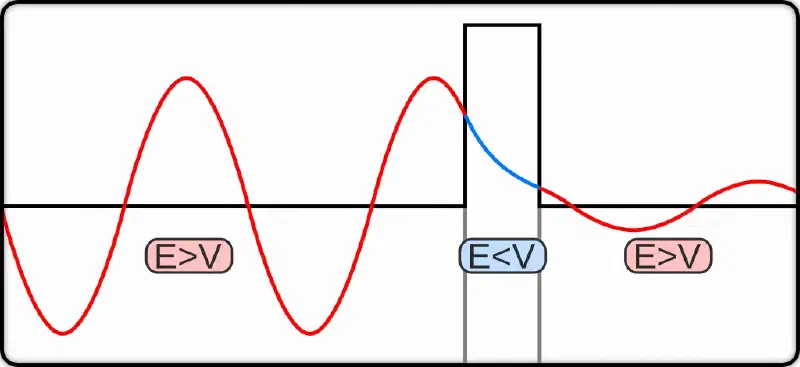
The energy (wavelength) of the particle does not change before and after tunneling, but the probability amplitude decreases.
Tunneling Probability P #
It is defined as the ratio of the number of electrons in the transmitted wave to those in the incident wave passing through a unit area per unit time.
For an arbitrary barrier shape:
$$P\fallingdotseq A\cdot \exp\Big(-\frac{2}{\hslash}\sqrt{2m}\int_{0}^{x_1}\sqrt{|V(x)-E|}\cdot dx\Big)$$When $E=V_1/2$:
$$P=4\cdot \exp \Big(-\frac{2m\sqrt{gh}}{\hslash}\cdot W\Big)$$